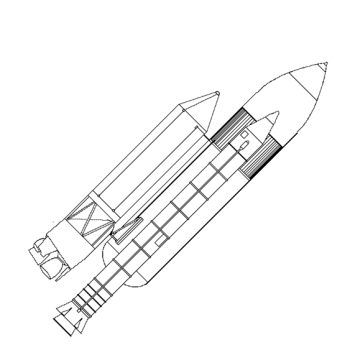
Part Two of a series on CEV design & launch concepts
Kevin Waldroup expands on the ideas for Shuttle-C and discusses the possibilites of variants and space station applications using the external tank and other components of the existing shuttle infrastructure.
Posted by jburk at July 28, 2024 10:39 AM | TrackBackGreat job showing all the resources and for putting it all together in a simple to read format.
Thank you
As noted shuttle derivatives are scalable and I am sure with a little effort so are other rockets that are currently in use.
Has anyone given any more thought to the actual crew area other than the big Gemini or apollo Plus redu?
Posted by: Harold LaValley at July 28, 2024 11:28 AMSRBs, ET. These are the modules that lost us 2 orbiters. Bad karma? Using SSME? Launching people on SRB? It does not "feel" that right to me.
Posted by: Gerhard Hauer at July 28, 2024 12:10 PMSuggest adding this link:
http://www.nsschapters.org/ny/nyc/Shuttle-Derived%20Vehicles%20Modified.pdf
Also please correct typos.
Shawn or Sean O'Keefe for example.
Posted by: Bill White at July 28, 2024 01:28 PMGood stuff! I like the designs.
BTW, that would be "Sean" not "Shawn" O'Keefe.
Posted by: FredKiesche at July 28, 2024 07:38 PMIn fact, I'm linking it to my blog. Any variant of the space shuttle is worth looking at!
Posted by: FredKiesche at July 28, 2024 07:41 PM"The CEV would be launched on a new human-rated vehicle based on the existing shuttle solid rocket motor (SRM), augmented with a new liquid oxygen (LOX)-hydrogen upper stage. Such a system could be available by 2011, allowing the shuttle orbiter to be retired as planned. If ISS assembly has not been completed by that date, the remaining international modules can be deployed on the heavy-lift launch vehicle (HLLV) that must be developed to support the proposed exploration initiative, or on suitable international vehicles such as Ariane or Proton. The study group supported the use of foreign launch vehicles in the space station assembly."
http://planetary.org/news/2004/cev-development0722.html
Nice to see you've got the US weaponizing space as part of your 'system'. Will set a great precedent for others to follow. Otherwise quite a good system, the external tanks forming a wheel station sounds a little like Space Island's idea. Can't see Russians buying US boosters at many times the cost of their own.
Posted by: Craig Ritchie at July 29, 2024 02:41 AMHere is another link thanks to another blog site.
http://www.nsschapters.org/ny/nyc/Shuttle-Derived%20Vehicles%20Modified.pdf
To answer that question here is a link for A full-scale mock up of a Shuttle C concept sits at the Marshall Space Flight Center in Alabama in this 1989 image.
http://www.space.com/php/multimedia/imagedisplay/img_display.php?pic=shuttle_c_031113a_02.jpg∩=A%20full-scale%20mock%20up%20of%20a%20Shuttle%20C%20concept%20sits%20at%20the%20Marshall%20Space%20Flight%20Center%20in%20Alabama%20in%20this%201989%20image.
An artist's concept from the early 1980s shows a Shuttle-C cargo element in Earth orbit carrying the Galileo probe to Jupiter.
http://www.space.com/php/multimedia/imagedisplay/img_display.php?pic=shuttle_c_031113c_02.jpg∩=An%20artist's%20concept%20from%20the%20early%201980s%20shows%20a%20Shuttle-C%20cargo%20element%20in%20Earth%20orbit%20carrying%20the%20Galileo%20probe%20to%20Jupiter.
http://www.astronautix.com/lvs/shuttlec.htm
http://www.astronautix.com/graphics/s/shuttled.gif
Shuttle-B: Flexible Use of NASA's Space Transportation System
http://www.spacedaily.com/news/oped-03zzs.html
Many more sites are still to be found some dating back to the early 80's.
Personally I like the build full scale mock unit from 1989.
"The CEV would be launched on a new human-rated vehicle based on the
existing shuttle solid rocket motor (SRM), augmented with a new liquid
oxygen (LOX)-hydrogen upper stage. Such a system could be available by
2011, allowing the shuttle orbiter to be retired as planned."
http://planetary.org/news/2004/cev-development0722.html
U.S. Expendable Launch Vehicles
p18to 22
http://planetary.org/aimformars/study-report.pdf
I think that if NASA is going to use a shuttle derived vehicle it should be based on the Ares layout for the heavy & super heavy class.
The reason for this would be to get a quicker return on investment for the what ever redesign is required of the ET.
There would be the added benefit of keeping cargo & crew above shedding foam...
Hi...Since we have ALOT of readers here I feel compelled to let it be known that if Mr. John Kerry is elected,President, Bush's inniative for the Moon and Mars will be lost !!! John Kerry was here at Cape Kennedy and I expected him to say something about the Space Program and where we would be headed under His administration,..NOT ONE WORD !!!I was really shocked.....So my friends although Mr.Bush is a bit arrogant and doesn't take "No " for an answer...the economy is booming and the US is 100 times safer than it was before Sept 11...Mr.Bush is a " Can Do " President..... Mr. Kerry?..well...he would make a " Can Wait " president......A vote for Kerry is a vote for " Manned Space Exploration Stagnation ".....Vote for Mr. Bush and join his wagon train to the New Frontier...Thanks...Jake
Posted by: jake at July 29, 2024 09:16 AMAs others have noted the SDV was never intended to be man rated but only as a cargo ferry. This is a great first step in reducing ISS transportation costs of construction and of resupply as needed. But this does not resolve the need for a crew transport only the number of forced trips by the shuttle for this purpose. I feel that a capsule mounted on top of the External tank with a small menuevering booster would be a good place for the CEV man rating to happen. This would further off load the shuttle need for being the main crew transport.
Being four or five times more powerfull than needed for the load factor at launch. It would mean that the external tank could be brought to orbit rather than throwing it away with fuel remaining still in it.
This then could be adapted to the role of boosting the ISS orbit.
It also could mean usinging it as the building block for other advanced ships to mars.
Using the empty tanks to enlargen the ISS and lots of other things I am sure could be done with them.
UPI Exclusive: NASA Begins Moon Return Effort
illustration only
by Frank Sietzen
Washington (UPI) Jul 29, 2024
http://www.spacedaily.com/news/spacetravel-04zq.html
FYI, Part Three will likely be posted Saturday morning; I'm still working on it :)
Posted by: James Burk at July 29, 2024 08:49 PM
Everybody, Thank YOU comment on article.
I am working on a follow up article.
Reading between the lines of the two recent UPI articles regarding developments in project constellation it would appear that foreign launch systems are being seriously considered. And why not?
Currently the US has one man rated launch system, the Shuttle Launch System, which currently only launches the Shuttle. The Delta and Atlas launchers are not man rated. However ESA has a ready built man rated launch system - the Ariane 5. This launch system is quite capable of launching a CEV (Capsule or Lifting Body) to LEO for docking with the ISS or for transfer to the Moon with the aid of a separately launched transfer stage.
It has been proposed by some that a single SRB be used together with a liquid fuelled second stage to launch a CEV, the reason being that the SRBs are man rated. This is a dangerous path to follow, for although they are now very reliable on launch, from the moment the segments are poured in the factory they are bombs waiting to go off, either in transit or assembly or on the launch pad.
What matters most in this project is how much hardware and how many different systems can be deployed in space and on the Lunar surface. The necessary launch systems to do this already exist and it would be foolish to spend more than necessary on developing alternative launch systems, especially on such a tight budget. Remember this is Not Apollo.
I would propose that Astronauts are launched from Kourou on the Ariane 5. Although the Ariane 5 uses SRBs, the CEV would be mounted on top of the stack, allowing the use of a simplified escape system. If any further R & D is needed in man rated launchers it needs to be directed towards liquid fueled fly-back boosters. The Technology developed here would be applicable accross the whole range of of launcher types.
http://www.esa.int/SPECIALS/Launchers_Access_to_Space/SEM20W67ESD_0.html
http://www.starbooster.com/Buzz62101.pdf
http://www.russianspaceweb.com/baikal.html
The Delta and Atlas variants can be used to launch other medium sized hardware such as transfer stages and landers etc. The Delta IV Heavy doesn’t have an ‘engine out’ capability, and is in my opinion less suitable for man rating than the Atlas.
http://www.boeing.com/defense-space/space/delta/delta4/delta4.htm
http://news.bbc.co.uk/1/hi/sci/tech/2207633.stm
http://www.astronautix.com/engines/rs68.htm
http://www.astronautix.com/engines/rd180.htm
The Shuttle Launch System can be adapted to form a heavy lift launch system, capable of launching the heavier plant required for development of Lunar resources, such as nuclear reactors, lunar rovers, base modules, mining equipment, the L1 space station etc.
http://www.starbooster.com/TALAYPanel3FINAL.pdf
http://www.starbooster.com/032504SlidesAldrin.pdf
If no use can be found for the expensive external tank other than to ditch it in the Indian Ocean, then for future Mars missions and Solar System exploration, serious consideration should be given to licensing Russian technology such as the Energia system and developing the reusable system elements originally planned for it. This would save time and money, and the R & D expenditure would be for new items and not for what has already been invented. This system could also launch a Mk2 Space Shuttle based on the best elements of the existing one and the Russian Buran.
Remember its what's in Space and what you do with it, that will in the end count. The launcher is just a means to an end. Although as a symbol of a nations space faring prowess, the thought of using a ‘foreign’ launch rocket is a hard pill to swallow, it can be sold, if it is seen that the project as a whole is of a much greater magnitude in size, scale and duration than the Apollo program was.
http://www.k26.com/buran/index.html
http://www.energia.ru/english/energia/launchers/vehicle_energia.html
Pages below in Russian - good pics though:
http://www.buran.ru/htm/family.htm
http://www.buran.ru/htm/41-3.htm
Other Links of interest.
http://habitablezone.com/space/messages/334247.html
http://gltrs.grc.nasa.gov/reports/2002/TM-1998-208834-REV1.pdf
http://ares.jsc.nasa.gov/HumanExplore/Exploration/EXLibrary/docs/MarsRef/addendum/index.htm#Title
http://www.cruiser.ru/eng/avanproject2.php
http://www.spaceislandgroup.com/home.html
Posted by: Andy McSorley at August 3, 2024 08:57 AMNicely written by the way Andy:
That would also put the cancelled projects of the OSP, SLI, the x-38 and other series as viable options for use with the Ariane launcher for the CEV. Near term as well for use.
But much like the fact of not being able to pay for the seats on a Rusian soyuz can we purchase said equipment from the Europeans.
My other thought is of launch sites both here and over seas that are capable of launching rockets in that how many are there that would be favorable for use if launch activity were to step up.
Posted by: Harold LaValley at August 3, 2024 11:25 AMI think that trying to make this an international effort would be a mistake. Who here thinks that the ISS program has been run affectively? By going outside the U.S. we're just making it worse on ourselves. NASA is bad enough as is, transforming it into the U.N. of space is not going to help.
I have a question on the SRB. Can the SRB explode in flight? If so, how come they didn't explode in the Challenger accident?
No matter what type of propellant or the design of the shape takes it still boils down to funding and of the complete rocket plus launch ect.. cost to operate it.
We must keep costs down in the design phase, construction and in its normal use or we will fail.
Posted by: Harold LaValley at August 10, 2024 08:40 AMIt depends what on we mean by 'International'. Apart from the All American space shuttle launch system, the companies involved in the remaining military and commercial launch systems work with international partners. The USAF supports the Atlas program that uses the Russian derived RD-180 engine. The Sea Launch consortium that includes Boeing uses Russian RD-171 engines on the Zenit derived first stage which was originally a booster for Energia (RD-170). In the late 90s improvements were being sought by NASA for the SSME by incorporating a Russian derived nozzle from the RD-0120.
I think the problem with the ISS is it ended up trying to be all things to all men, with no Main Mission. It could still be used as a staging post for Lunar and Interplanetry missions, perhaps with free flying anexes, repair shops and re-fueling depots nearby. It should not be wrtten off.
Operations for Project Constellation would obviously be run by the US. But even Apollo required co-operation from friendly nations for communication relays. So even that program had a small international element in it.
I'm sure I could go on.
Posted by: Andy McSorley at August 10, 2024 12:12 PMThe level of internationism you're talking about is lower than what I'm talking about. I think that it's a good idea to look at other technologies from around the globe. What I'm refering to is partnerships in which we are totally dependent on like ISS. Now Russia wants to take advantage of us because they know we can't get to the station. Before that they held up the assembly of ISS with some of the components that were needed. I think that for future programs we should limit the dependency so we can evoid risking a program like we did with ISS.
Posted by: Ken at August 13, 2024 04:09 AMThe Little Hercules launchers
By Kevin ,J waldroup
Little Hercules Tourist
The Medium Lift Hercules, or Little Hercules is a solid rocket booster with a second stage hydrogen fueled J2 class rocket engine that can launch 40,000 pounds into low Earth orbit. It will able to launch the new NASA spaceship I call "Clementine".
The Little Hercules will launch government spacecraft and will also launch private based craft that will launch tourist into low Earth orbit. The spacecraft will be based on what was called back in the 70's Big Gemini. The big Gemini can launch 10 tourist instead of the Soyuz 3, or the Shenzhou which can carry 4 space tourist. The Big Gemini will use a paraglider that can be guided to an airport and landed on a runway.
The Little Hercules will use Russian spacecraft like the Soyus and the Kliper while we wait for the Big Gemini to be built. It will probably take tourist to Bigelow’s inflatable space hotels, or the International Space Station, or an external tank built space hotel.
Improved Little Hercules
The class A or basic Little Hercules design have 2 stages. A solid Rocket Booster, that is fully reusable, the chemical 2nd stage is non-reusable. The basic package will be used to launch the Clementine into low Earth orbit. This basic design will also be used to launch tourist into orbit.
The class B will add 4 strap on chemical rockets that are similar to the Long March rockets used by the Chinese. We will have to use a cleaner fuel because the United States is judged by a different standard, environmentally. With the 4 strap on boosters will be increased from 40,000 lbs to approximately 48,000 to 50,000 lbs. The class C is basically a Little Hercules with 2 solid rocket boosters attached. It will be able to lift approximately 60,000 lbs. Into low Earth orbit.
The improved Little Hercules used a 5 segment solid rocket booster with an improved chemical upper stage. This should increase the payload of the Little Hercules from 40,000lbs to 50,000lbs.
CONCLUSION
Space Tourist
By using the Little Hercules for tourism it will increase the areas where you could launch the vehicle and reduce the cost. Little Hercules launch sites could be set up around the country in various locations. By spreading the launch around the country it will reduce the likelihood of the program being reduced or canceled by congress.
Improved Little Hercules
The Little Hercules is a modular design which can be configured to launch cargo, or tourist, and astronauts. It is based on the very reliable solid rocket booster that has only failed once in its entire history. However by modifying it you might have problems with the chemical upper stage. That is why I have decided to use the j2 class engine that was part of the Saturn rocket that took us to the moon. The basic Clementine will be a basic capsule design that will have an escape tower.
References
Hercules Exploration System
by Kevin J, Waldroup
http://www.projectconstellation.us/article...s/hercules.html
Soyuz Tourist Trips to the Moon?
Space News July 27
Advanced Gemini: What NASA Needs
by Mike Majeski
http://www.projectconstellation.us/article...ced-gemini.html
Inflatable POOFs
by Taylor Dinerman
Monday, July 19, 2024
http://www.thespacereview.com/article/187/1
U.S. Expendable Launch Vehicles
p18 To 22
http://planetary.org/aimformars/study-report.pdf
I have a lot of heavy-lift links at:
www.starshipmodeler.net
Go to the Real Space Modeling section, and look under "Buran Vs. Dyna-Soar"
Posted by: Jeff Wright at December 16, 2024 01:01 PM